
How to Use This Interest Calculator Canada
This interest calculator Canada page has three tools in one. Pick the tab that matches your question:
- Compound interest — how much a deposit grows when interest earns interest, with optional regular savings.
- Simple interest — interest on the original amount only, by year, month or day. Useful for short-term loans and some GICs.
- Savings goal — works backwards from a target to the amount you need to save each month, bi-weekly or weekly.
Move the sliders or type exact numbers. Results, charts and tables update instantly, and you can download the year-by-year table as a CSV for your own spreadsheet.
Interest Calculator Canada: Simple vs. Compound Interest
Simple interest is paid only on the money you started with. Compound interest is paid on your money plus the interest it has already earned. Over a few months the difference is tiny; over decades it's enormous.
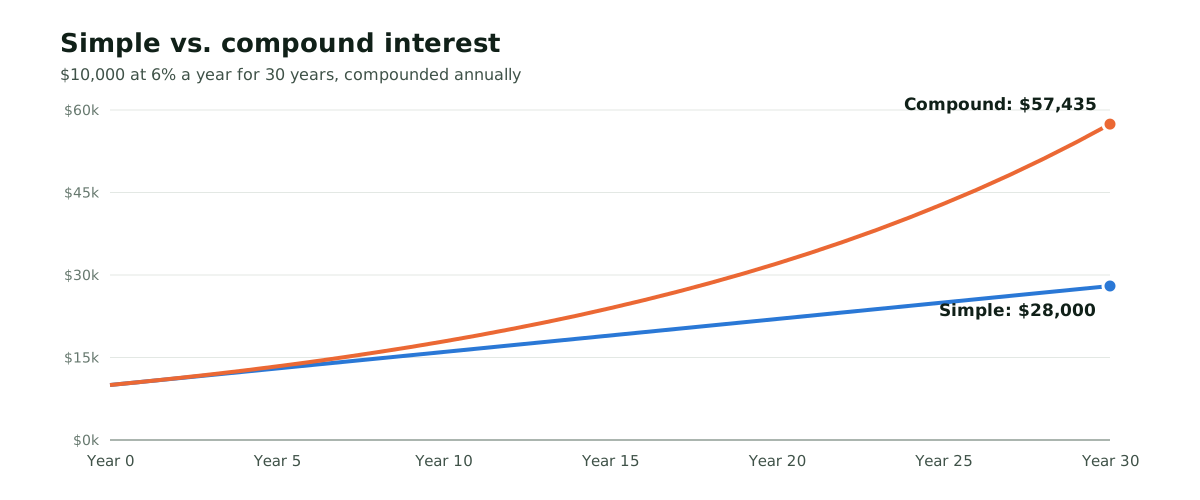
When you borrow, compounding works against you. That's why paying down a credit card or loan early saves more than you might expect.
Interest Calculator Canada Formulas Explained
Simple interest
$5,000 at 4% for 3 years: 5,000 × 0.04 × 3 = $600 of interest.
Compound interest
$5,000 at 4% compounded monthly for 3 years: 5,000 × (1 + 0.04/12)36 = $5,636.36, so $636.36 of interest.
With regular contributions
Here C is each contribution, i is the interest rate per contribution period and k is the number of contributions. The calculator converts your compounding frequency into the matching rate per period, so monthly saving with annual compounding is handled correctly.
Interest Calculator Canada: How Compounding Frequency Changes Your Return
The more often interest is added, the faster your money grows — but the effect is smaller than most people think. Here is $10,000 at 5% for 10 years:
| Compounding | Balance | Interest | Effective annual rate |
|---|---|---|---|
| Annually | $16,288.95 | $6,288.95 | 5.000% |
| Semi-annually | $16,386.16 | $6,386.16 | 5.062% |
| Quarterly | $16,436.19 | $6,436.19 | 5.095% |
| Monthly | $16,470.09 | $6,470.09 | 5.116% |
| Daily | $16,486.65 | $6,486.65 | 5.127% |
Going from annual to daily compounding adds only a few hundred dollars here. The rate and the time matter far more than the frequency.
Interest Calculator Canada for TFSA, RRSP and FHSA Savings
Where you hold your savings changes how much interest you keep:
| Account | Tax on interest | Good to know |
|---|---|---|
| TFSA | None — growth and withdrawals are tax-free | Annual contribution limit is $7,000 for 2026; unused room carries forward. |
| RRSP | Deferred until you withdraw | Contributions reduce taxable income now; withdrawals are taxed later. |
| FHSA | None if used for a qualifying first home | $8,000 a year, $40,000 lifetime, for first-time buyers. |
| Non-registered | Taxed every year at your marginal rate | Interest is fully taxable, unlike dividends or capital gains. |
Limits change over time — confirm your personal contribution room in your CRA My Account.
To see how regular deposits grow inside a TFSA or RRSP, use the compound interest calculator Canada page.
The Rule of 72
A quick mental shortcut: divide 72 by your annual interest rate to estimate how many years it takes to double your money.
| Annual rate | Rule of 72 | Exact (annual compounding) |
|---|---|---|
| 2% | 36.0 years | 35.0 years |
| 3% | 24.0 years | 23.4 years |
| 4% | 18.0 years | 17.7 years |
| 5% | 14.4 years | 14.2 years |
| 6% | 12.0 years | 11.9 years |
| 8% | 9.0 years | 9.0 years |
| 10% | 7.2 years | 7.3 years |
The calculator's Time to double figure uses the exact formula for whatever compounding you choose.
Interest Calculator Canada: The Interest You Pay on Loans and Mortgages
Interest works the same way when you borrow — you're just on the other side. A few Canadian rules worth knowing:
- Mortgages with a fixed rate compound semi-annually, not monthly. Our mortgage calculator Canada applies this automatically, along with CMHC insurance and land transfer tax.
- Loans and lines of credit usually charge interest on the outstanding balance. See the loan interest calculator Canada or EMI calculator Canada.
- Not sure what rate you're really paying? The interest rate calculator Canada works out the APR from your loan amount and payment.
- Since January 1, 2025, Canada's criminal interest rate is 35% APR; most loans above that are illegal.
Interest terms in plain English
- Principal
- The money you deposit or borrow.
- Interest rate
- The yearly percentage charged or paid on the principal.
- Compounding
- Adding earned interest to the balance so it earns interest too.
- Effective annual rate
- What the rate is really worth in a year once compounding is included.
- Prime rate
- The rate banks base variable loans on; it moves with the Bank of Canada's policy rate.
- Term
- How long a deposit or loan agreement lasts.
Interest Calculator Canada – Frequently Asked Questions
How do I calculate interest in Canada?
For simple interest, multiply the principal by the annual rate and the number of years: I = P × r × t. For compound interest, use A = P(1 + r/n)nt, where n is how many times a year interest is added. The interest calculator Canada tool above does both and shows the result year by year.
Is interest calculated daily or monthly in Canada?
It depends on the product. Most Canadian savings accounts calculate interest daily and pay it monthly. GICs usually compound annually. Fixed-rate mortgages must compound semi-annually or annually by law, while credit cards and many loans charge interest daily or monthly.
What is the difference between APR and APY?
APR is the stated annual rate. APY (or effective annual rate) includes the effect of compounding. A 5% rate compounded monthly has an effective annual rate of about 5.116%. The calculator shows this as “Effective annual rate”.
Is interest income taxable in Canada?
Yes. Interest earned outside a registered account is taxed at your full marginal rate in the year it is earned. Inside a TFSA it is tax-free, and inside an RRSP or FHSA it is tax-deferred.
How long does it take to double my money?
Divide 72 by your annual rate for a quick estimate (the Rule of 72). At 6% it takes about 12 years. The calculator shows the exact doubling time for the rate and compounding you choose.
Does this interest calculator work for all provinces?
Yes. Interest maths is the same across Canada. Province matters for mortgage closing costs and sales tax, which our mortgage calculator and car loan calculator handle.
Is this calculator free and private?
Yes. It's free, needs no sign-up, and every calculation runs in your browser — nothing you enter is sent anywhere.
Results are estimates for education only. Lenders and financial institutions set your actual rate, payment and terms. See our disclaimer.